How Google Decides Which Local Businesses Show Up First
A homeowner in Cape Coral has a dripping faucet under the kitchen sink. They pull out their phone and search for a nearby repair service. A few local businesses appear before they have time to think much about it.
If you run a plumbing, painting, grooming, cleaning, or repair business, that moment matters. The person searching may be close by and ready to reach someone. But Google, not you, decides which local options it shows first.
There is no switch to flip and no payment that buys a better local placement. There are, however, useful things you can keep accurate and current so Google and a person searching can understand your business.
Why the local results matter
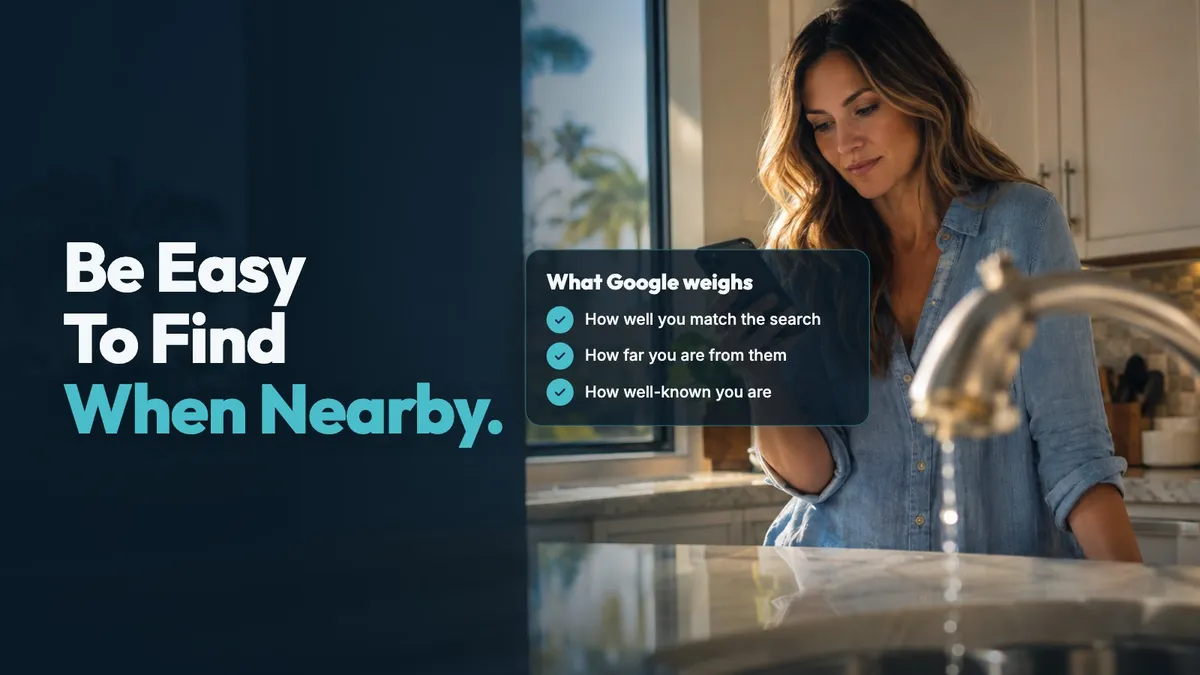
Google explains its local results in three plain ideas: relevance, distance, and prominence.
Relevance means how well your Business Profile matches what someone searched for. If someone searches for a house painter in Fort Myers, Google is looking for businesses whose information fits that need.
Distance is how far the business is from the person searching, or from the place named in the search. A great profile in Naples may not be the closest fit for someone standing in North Fort Myers. You cannot control where the person is when they search, and you should not pretend you serve an area you do not serve.
Prominence is Google’s word for how well known a business is. Google says this can be based on information such as links from other websites and reviews. On its local results help page, Google also says that more reviews and positive ratings can help. The same page is clear that nobody can request or pay for better local placement.
That does not mean a complete profile puts you in a certain spot. It means your business information has a better chance of being understood as it is. Google makes the final choice for each search, and the results can change with the search, location, and other information Google uses.
Why pay attention to the businesses shown near the beginning? A 2007 eye-tracking study in the Journal of Computer-Mediated Communication found that college students clicked Google results placed higher on the page more often, even when lower results had summaries that better fit their task. The authors saw substantial trust in the order Google displayed.
That is not a promise about what any homeowner will do today. It is a useful reminder that people often make quick choices when they need help. When they do find you, they should see accurate hours, a clear description of your work, and an easy way to reach you.
Search is changing, but the basics still matter. Google’s documentation about AI features in Search says the usual website best practices still apply to AI Overviews and AI Mode. Google says there are no additional requirements or special optimizations needed to appear in those features. A page must be indexed and eligible to appear in Google Search with a snippet to be shown as a supporting link, though Google says meeting those requirements does not mean it will be shown.
What you can check this week
You cannot control every local result. You can make it easier for a person and for Google to see the basics of your business. Set aside a little time to look at what is already public.
- Read your Business Profile as a customer would. Is the business name correct? Does the main category describe the work you want to be known for? Read the description, phone number, address or service area, and website link. Remove old details that could send someone in the wrong direction.
- Check your hours. A customer who sees open hours and reaches a closed phone line may move on quickly. Update regular hours when they change. Before holidays, check that the public information still matches your real schedule.
- Use an honest service area. If you work from Cape Coral to Naples, say only where you actually go. If certain islands, neighborhoods, or towns are outside your normal route, do not create confusion by listing them as though they are not.
- Make your own website specific. Your site should plainly say what you do and where you work. “Handyman services” is broad. A page that explains the jobs you handle, your Southwest Florida service area, and how to contact you gives a searching person useful information.
- Keep your contact details aligned. Your phone number, hours, services, and business name should not tell one story on your website and another on your Business Profile. Make a small list of those details so future changes are easier to check.
- Ask for reviews after real visits. A steady habit is better than a sudden rush. Ask people who have actually worked with you. Do not write reviews for yourself, offer something in return for a positive review, or pressure someone about what they should say.
- Reply with care. Thank people for taking the time to leave a review. For a concern, keep the public reply calm and brief. Do not share a customer’s private details. Offer a clear way to continue the conversation directly when that makes sense.
A 2017 study in Marketing Science looked at hotels that replied to online reviews. The hotels that responded saw a 0.12-star increase in ratings and a 12% increase in review volume. They also received fewer but longer negative reviews after they started responding. This was research about hotels, not Southwest Florida trades, so it is not a prediction for your business. Still, it supports the common-sense value of paying attention when people take the time to comment.
How Deja Vu Marketing can help
We build a website on your own domain that says what you do and where you work. Your domain is in your name, and you own your pages. Clear service and location information gives visitors a straightforward place to check the details after they find you.
Every plan also includes missed-call text-back from a local number. When you cannot pick up, your business number texts the caller back within a minute with a link to book. It includes one inbox for calls, texts, email, chat, and social messages, along with online booking and instant replies to web requests. The point is not to make a promise about placement. It is to help make sure a person who reaches you does not get lost in the shuffle.
We set up review requests after visits. On the AI plan, replies to Google reviews are included too. The AI Assistant answers website chat and texts day and night from your own information, offers open times, and books appointments. It follows your rules and is set up never to make up prices, times, or promises.
We do not promise a certain local result, call volume, or sales. Google controls its results. We focus on giving your business a clear home online and a system behind it for responding when someone reaches out.
See your website before you decide anything
Book a free 15-minute call and ask for a free preview. We'll build a sample website from your public Google listing before we talk, so you can see what yours could look like. We meet in person anywhere from Cape Coral to Naples, and it's month-to-month, with no contract.
Book your free 15-minute call or call or text (239) 990-3072. Our AI assistant answers day or night.
Sources
- Google. (n.d.). Tips to improve your local ranking on Google. Google Business Profile Help. Retrieved October 22, 2026, from https://support.google.com/business/answer/7091
- Pan, B., Hembrooke, H., Joachims, T., Lorigo, L., Gay, G., & Granka, L. (2007). In Google we trust: Users' decisions on rank, position, and relevance. Journal of Computer-Mediated Communication, 12(3), 801–823. https://doi.org/10.1111/j.1083-6101.2007.00351.x
- Proserpio, D., & Zervas, G. (2017). Online reputation management: Estimating the impact of management responses on consumer reviews. Marketing Science, 36(5), 645–665. https://doi.org/10.1287/mksc.2017.1043
- Google Search Central. (2025, December 10). AI features and your website. Google for Developers. https://developers.google.com/search/docs/appearance/ai-features