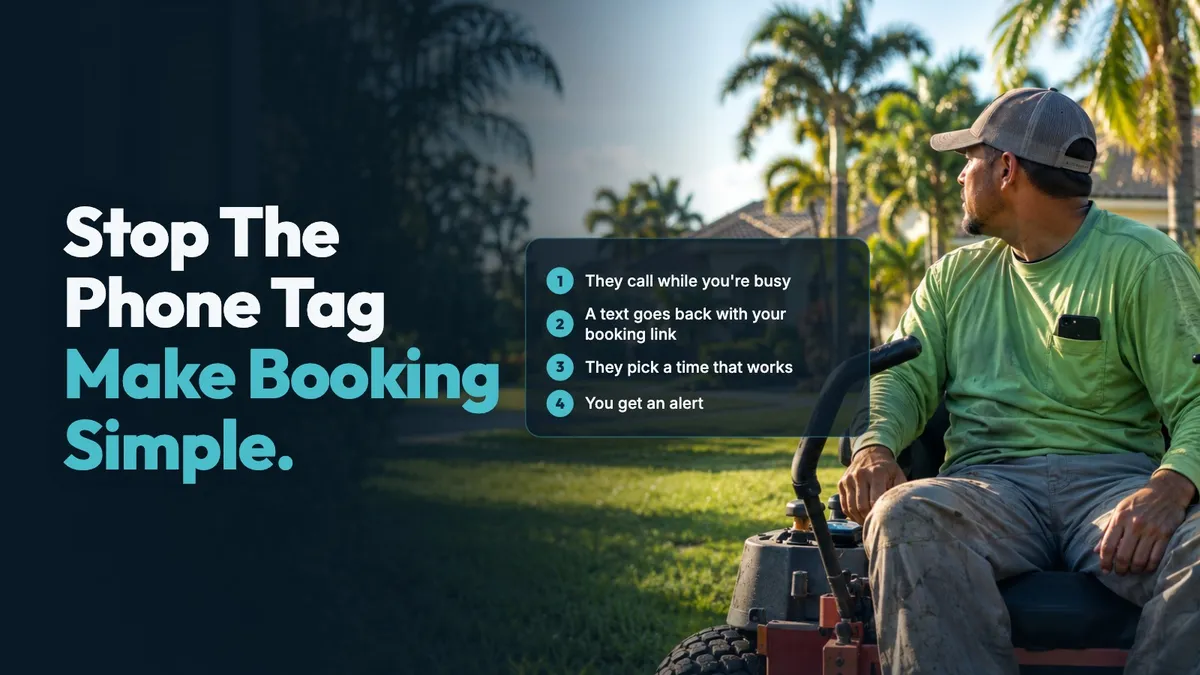
Phone Tag Is Costing You Customers
Phone tag costs you time because every missed connection gives a person time to keep looking. When someone is ready to ask about a service, make it easy to choose a time instead of asking them to call again.
Say you’re trimming a lawn in Bonita Springs, under a sink in Cape Coral, or with someone at the counter in Fort Myers. You can’t always stop for a ringing phone. The problem isn’t missing one call. It’s leaving the caller with no clear way to reach you or book.
Why phone tag matters
A person who calls a local business usually has a question, a need, or a task they want handled. They may be checking a few businesses at once. If they leave a voicemail and hear nothing, they may call the next name on their list. If you call back while they’re busy, the same loop starts again.
Speed matters, but the reply needs to feel useful. A 2026 Management Science study looked at more than 11 million conversations on a freelance marketplace. It found that service providers who replied faster were more likely to be hired. Cornell’s summary says a 5-minute delay lowered the odds by roughly 15%, while an hour’s delay lowered them by 46%.
That does not mean you need to sit beside your phone all day. It means the first response should give the person a next step. “Thanks, we got your message” is better than silence. “Here’s a link to choose a time that works for you” can remove a round of back-and-forth.
The same Management Science finding has an important caution. The benefit of speed disappeared when a reply appeared automated or AI-generated. Keep messages plain, accurate, and connected to the person’s question. Don’t claim a price, time, or service detail until you know it is right.
Written reminders can help people follow through. A 2013 Cochrane review of 8 randomized trials with 6,615 participants found that text-message reminders improved attendance at healthcare appointments. Attendance was 78.6% with a text reminder and 67.8% with no reminder. Text reminders worked about as well as phone-call reminders, at 80.3%, and cost less.
Those were healthcare appointments, not a home-service visit, salon appointment, or repair estimate. Still, the practical lesson applies. A written reminder gives people something they can check later. A clear text with the date, time, and details stays with them.
No-shows need a plan too. A 2016 study of clinic records at a Houston VA medical center found that patients missed 18.8% of appointments on average across 10 main clinics. In that setting, a centralized phone reminder moved the no-show rate only from 16.3% to 15.8%. The study reported an average no-show cost of $196 per patient in 2008.
Your business is not a medical center, and the point is not to copy its system. A reminder alone may not solve every missed appointment. Clear confirmation, an easy way to reschedule, and a quick follow-up after a missed visit are better than hoping someone remembers to call.
Make the next step easy this week
You do not need a complicated script. Look at the path from a first call to a confirmed appointment. Count how many times a person has to wait, call back, or repeat information. Each extra step is a place where the conversation can go cold.
- Put one booking link where people already look. Add it to your website contact page, business profile, and missed-call message. Use the same link each time.
- Let people choose from real open times. A person calling at lunch may only be free then. Someone checking services after dinner may not want to wait until morning to ask about an opening.
- Confirm appointments in writing. Send the service, date, time, location, and anything they need to know beforehand. If gate access, pets, measurements, or photos matter, say so before the appointment.
- Use a missed-call message that does one job. Thank the person for calling, identify the business, and give them the booking link. Don’t try to answer every possible question in one long text.
- Set a reply routine. Decide who checks new requests and when. If you work alone, that may be between jobs or after a service visit. A routine is better than relying on memory after a long day.
- Give people a clear way to say no. If someone is no longer interested, let the conversation end cleanly. Repeated messages after a clear no can waste time and damage trust.
- Have a no-show step. When someone misses a time, send a polite note with a way to reschedule. They may have forgotten, had a work emergency, or needed a different time.
It also helps to check your website from a customer’s point of view. Can someone tell what you do, where you work, and how to request a time without digging through several pages? Our guide to website mistakes that cost Southwest Florida small businesses customers covers common gaps that make the next step harder.
Keep the message clear, not pushy
A fast reply should reduce uncertainty. It should not pressure someone or pretend you know details you do not know. If a person asks for a price, answer when you have enough information. If the job needs an in-person look, say that plainly and offer a way to choose a visit time.
Think about the message from the other side. They may be in a hot driveway, planning around work, or calling between errands. A short written reply tells them their request did not disappear. A booking link lets them act without another round of voicemail.
Keep your wording consistent. Use the business name people recognize. Say what happens after they choose a time. If you need to confirm the appointment yourself, tell them. Clear expectations prevent avoidable confusion later.
How Deja Vu Marketing can help
We build websites with online booking, so people can pick an available time without waiting for a return call. When you can’t pick up, missed-call text-back sends the caller a text from your business number within a minute, with a link to book.
Our Lead Follow-Up texts and emails each website lead until they book or say no, for 30 days. Follow-up texts go only to people who contacted you or opted in, at most once a day, between 9 AM and 7 PM. They stop when someone replies, books, or texts STOP. When you mark a no-show, that person gets your booking link 15 minutes later.
See your website before you decide anything
Book a free 15-minute call and ask for a free preview. We'll build a sample website from your public Google listing before we talk, so you can see what yours could look like. We meet in person anywhere from Cape Coral to Naples, and it's month-to-month, with no contract.
Book your free 15-minute call or call or text (239) 990-3072. Our AI assistant answers day or night.
Sources
- Gurol-Urganci, I., de Jongh, T., Vodopivec-Jamsek, V., Atun, R., & Car, J. (2013). Mobile phone messaging reminders for attendance at healthcare appointments. Cochrane Database of Systematic Reviews, 2013(12), Article CD007458. https://doi.org/10.1002/14651858.CD007458.pub3
- Kheirkhah, P., Feng, Q., Travis, L. M., Tavakoli-Tabasi, S., & Sharafkhaneh, A. (2016). Prevalence, predictors and economic consequences of no-shows. BMC Health Services Research, 16, Article 13. https://doi.org/10.1186/s12913-015-1243-z
- Hart, E., VanEpps, E. M., Sezer, O., & Amir, O. (2026). Speed is a signal: When faster replies increase hiring likelihood. Management Science. Advance online publication (June 3, 2026). https://doi.org/10.1287/mnsc.2024.06185